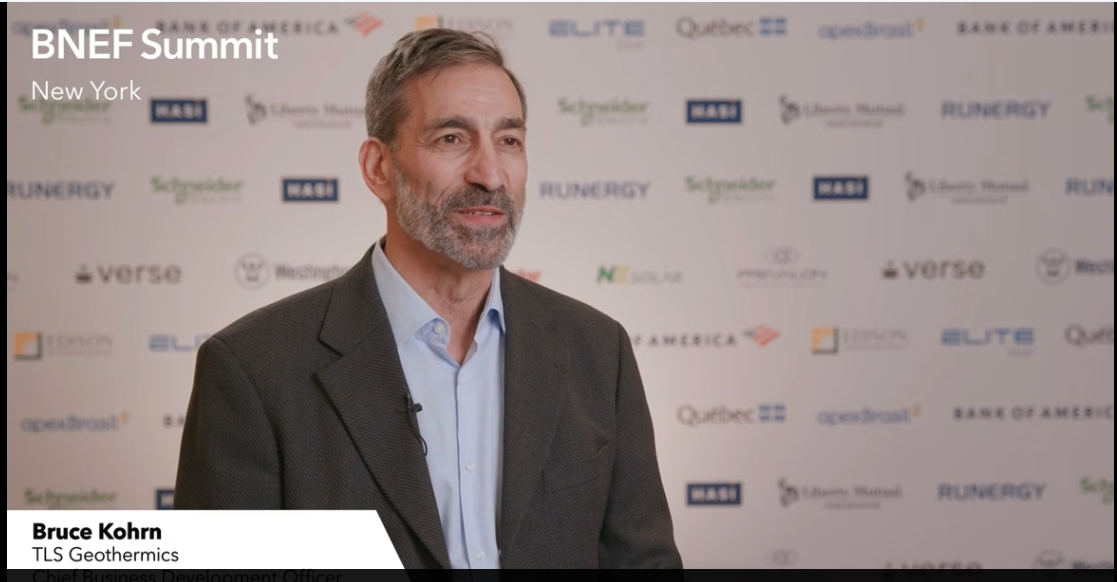
Bruce Kohrn recently joined Bloomberg for an interview at the Bloomberg NEF Summit New York.
In this BloombergNEF Summit New York interview, Bruce Kohrn, Chief Business Development Officer at TLS Geothermics, outlines a new investment thesis for geothermal energy: better data, smarter siting, and stronger community alignment. As national power demand rises and grid access becomes increasingly competitive, geothermal’s next phase will depend on more than resource potential alone. Bruce discusses how artificial intelligence, advanced subsurface modeling, public datasets, and field-validated exploration tools are helping TLS reduce drilling uncertainty and identify hidden geothermal systems. He also highlights the importance of early stakeholder engagement, transparent risk communication, and long-term community value as essential foundations for scaling geothermal into a larger part of the clean energy mix.
Read the full transcript below (if you wish) and as always connect with us for more information about our exploration workflow, geoscience services or stakeholder engagement roadmap: Contact@tls-geothermics.com
Thanks for tuning in,
Rusty Muscarella
Full Transcript (5 minute read):
Interviewer: Geothermal energy is clean baseload power. Given those qualities, what is its potential in the U.S. today to meet growing power needs?
Bruce Kohrn: The opportunity for geothermal power is massive. Just yesterday, during this conference, I heard that demand requirements for power are growing significantly. The Department of Energy has estimated that geothermal could deliver 120 to 140 gigawatts of power with available technology.
If research and development continue to advance, and we are able to drill deeper and hotter, we can start talking about terawatts of power. The key thing is that this represents enormous investment potential.
Interviewer: Traditionally, when people think of geothermal, they think of assets in geologically active areas where there are geysers, hot springs, or other surface evidence. But with the work you’re doing, you’re essentially mapping hidden systems. What is the potential impact of the latest machine learning techniques and tools on geothermal exploration?
Bruce Kohrn: AI is transformative for geothermal exploration. The real edge is the ability to use AI to create predictive models.
Traditional geothermal exploration has moved beyond simply looking for hot springs at the surface. We are now trying to understand the plumbing of the system below the surface. AI allows us to look deeper and identify hidden resources.
It is similar to the quantum leap the oil and gas industry made in the 1980s and 1990s. Oil and gas companies stopped looking only for surface seeps and began using advanced subsurface tools to find hidden reserves. We are leveraging similar technologies and algorithms, now advanced by AI, to find hidden geothermal systems.
Interviewer: So it sounds like geothermal is at a moment where AI tools, advanced machine learning, and engineering techniques are coming together in a new way.
Bruce Kohrn: Yes, we are absolutely at the beginning of a new moment. The capability that we now have allows us to move from what might be described as guesswork, or drilling wells based on limited information, toward predictive modeling with much higher accuracy.
Our tools have been able to demonstrate this recently. As we drilled our first wells in Nevada, our modeling tools proved to be highly predictive, and that is very exciting for our team.
Interviewer: When you are developing those modeling tools, what data streams are you putting together to make predictions about where a geothermal asset might be worthwhile?
Bruce Kohrn: We start with publicly available, large datasets for geology, geochemistry, and geophysics. We use AI across those datasets, and the AI is trained on geothermal power plants that already exist in Nevada and the western U.S.
We start there, but every time we drill a well, we turn our project flywheel and our development flywheel. Every well adds new data. Every well improves our modeling and our modeling tools.
Interviewer: TLS has projects in the U.S. and Europe, which are very different geological and regulatory environments. When you think about those key markets, what does it take to move from exploration to commissioning?
Bruce Kohrn: Europe is our birthplace, and the regulatory, permitting, and stakeholder engagement process is complex there. The United States is a little more straightforward.
We are working on federal lands in Nevada, where permitting is easier. The Trump administration, and the Biden administration before that, both took steps to accelerate the permitting process.
The real bottleneck now is being able to connect to the grid. We can take certain steps by selecting our sites very carefully, not only based on geothermal potential, but also based on proximity to the grid, the capacity of the grid, and the system at that point.
There are also other models for direct offtake agreements that could help accelerate development. The bottleneck right now is grid access.
Interviewer: That is something we are hearing a lot at this summit: speed to grid and speed to power. Is that an area where geothermal has a major challenge compared to, say, a new gas project? It feels like geothermal has a longer lead time.
Bruce Kohrn: I can’t say whether we have a longer lead time compared to gas-powered systems. The challenge for both is around supply chain, because some materials are becoming more difficult to access.
Geothermal also has issues around potentially having access to transformers. It is part of a complex global supply chain.
Interviewer: When you look around the world at geothermal projects, there is sometimes opposition from communities. The idea of drilling can raise concerns. I know from looking at your website that stakeholder engagement is something TLS is concerned about. What steps does TLS take when looking at projects to make sure all stakeholders are involved?
Bruce Kohrn: By and large, geothermal is very popular. It has strong support in communities, and it also has very strong bipartisan support at the state legislature and federal levels. But we don’t take that for granted.
In my experience, working very closely with community groups, what really matters is how we show up. How we show up really matters. I know I repeated that, but that is the point.
We show up early, we listen intently, and we are transparent about the risks involved.
I am on the board of Geothermal Rising. This is my first term on the board, and I see it as part of my responsibility to help raise the bar for community engagement and community support within the geothermal industry.
Ultimately, we want to deliver relevant, long-term value to the communities in which we operate. We don’t take popular support for granted. We have to nurture it, and we have to work at it.