

“Subsurface Intelligence Is Not About Better Visuals. It Is About Better Decisions”
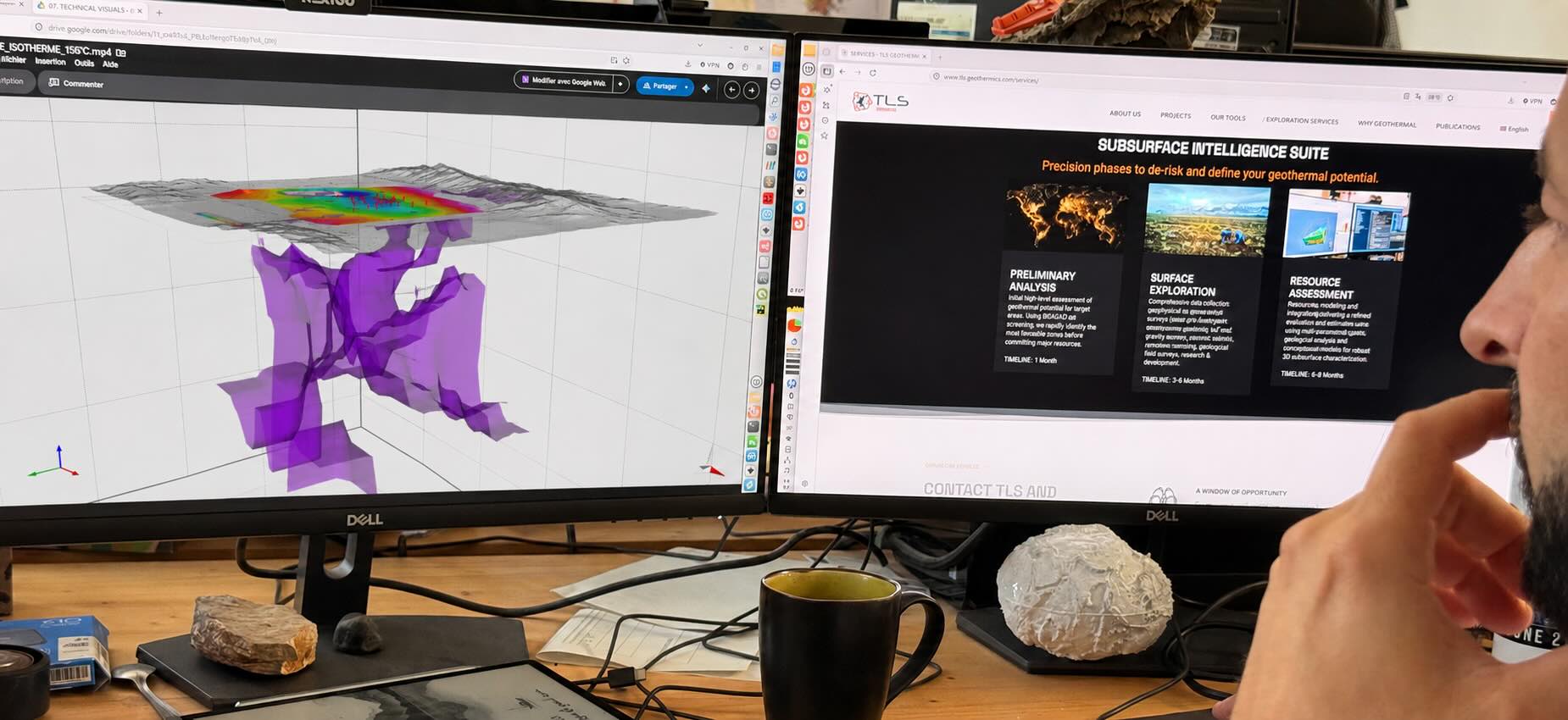
“The objective is not to make a prettier 3D model. The objective is to improve decisions.”
Mathieu Bellanger, Head of R&D, TLS Geothermics
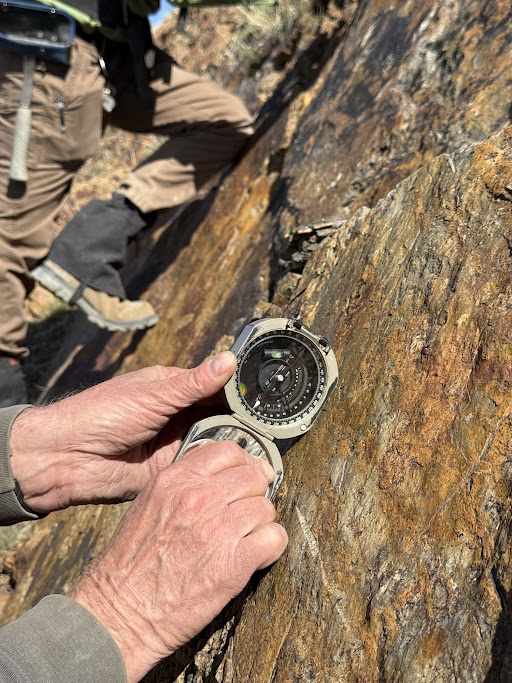
Before a geothermal prospect becomes a development project, a drilling program, or a bankable energy asset, one question comes first: do we understand the rock well enough to make the next decision?
Geothermal exploration is ultimately a subsurface uncertainty problem. Temperature matters, but temperature alone does not define a successful geothermal project. Developers also need to understand fluid properties, permeability and sustainability of exploitation aka how the natural system works. If you want to extract heat from hydrothermal system you need to understand permeability (brittle deformation, stress field, pre-existing geometry, internal structures, hydrothermal alteration, fracture infill, lithology, sedimentary layers, elastic contrast, crustal fault zone, karst, brittle layers, fracture network…), fluids (pH, Eh, pressure, isotopes, density, viscosity, salinity, gas content, species solubility, thermodynamics equilibrium (scaling), kinetic (dissolution), origin (metamorphic, magmatic, sedimentary, meteoric, mantellic, mixing)…) and heat (thermal conductivity and conduction (cover or salt effects, link between heat flux and geothermal gradient), radiation, radioactivity, latent heat (endo or exothermic chemical reactions), convection (gas flux, magmatic, hydrothermalism), friction, tectonic exhumation…) as well as the links between all of these elements.
This is why TLS Geothermics approaches exploration through a systems-based workflow. The objective is not simply to identify land that appears promising. The objective is to build a coherent geological concept before targeting a lease area, then refine that concept through increasingly constrained layers of data and interpretation.
The Concept Comes Before the Lease Area
In geothermal exploration, several first-order parameters need to be evaluated before moving forward. These include geodynamic context, structural patterns, lithological units, heat-flows, fluid pathways, and the broader geological architecture that may support a viable geothermal system.
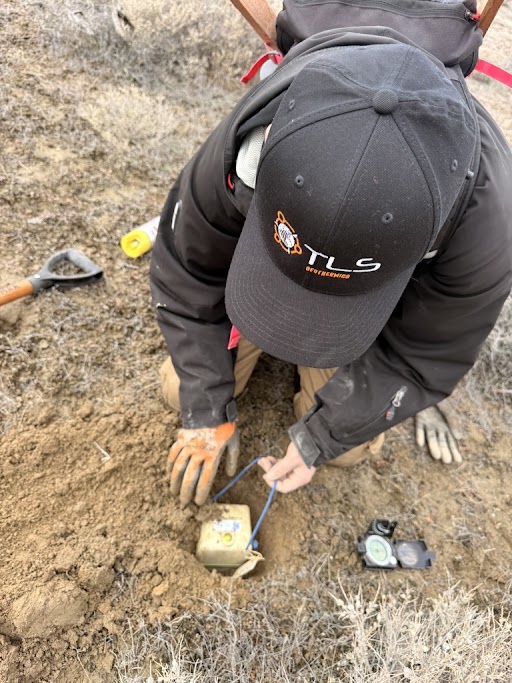
A systems-based approach begins by asking why a geothermal system may exist in a given region. From there, TLS integrates field acquisition, modeling and inversions within the geology-geochemistry-geophysics triptych as core tools for reducing uncertainty. These outputs are then combined with probabilistic quantification to support more disciplined decision-making.
This approach helps move geothermal exploration away from isolated indicators and toward a more integrated understanding of the subsurface.
Why Integrated Data Matters
No single dataset can fully describe the subsurface.
Geophysical (gravity, magnetotelluric, seismic, magnetic…), geological, and geochemical datasets each tell a different part of the story. Interpreted separately, they can produce several plausible answers. Infinite density distributions can explain gravity measurements. Electrical resistivity can be explained by electronic (graphit, ore…) or ionic (brine, smectite, magma, carbonatite, hydrogen…) displacement (grain boundaries, pore network from sedimentary, tectonic or alteration process). Seismic informations constrains plasto-visco-elasticity of the underground (mechanics, link between stress and strain) that strongly depends on porosity, mineralogy and fluid content. Geochemistry may point toward fluid origin(s) composition, temperature of fluids and rocks interactions.
Each dataset is useful, but each is incomplete on its own.
When these datasets are integrated through joint inversion and constrained by geological reasoning, they can help build a more coherent view of the subsurface. This is especially important in hidden geothermal systems, where surface expressions may be limited or absent.
Joint inversion helps reduce ambiguity bringing multiple physical-property datasets into a shared interpretive framework. Interpretation of this multiphysics using petro-physics and geology do not provide just a more detailed model, but a model that can better support technical and commercial decisions.
Better Models Should Improve Decisions
A 3D subsurface model has value only if it improves the decisions that follow.
The objective goes beyond making a more visually impressive representation of the subsurface. The objective is to support clearer answers to practical exploration questions:
- Where should more data be acquired, such as geochemistry or thermal measurements?
- Where are lithological boundaries likely to influence system behavior?
- Where may structures support permeability?
- Where does drilling risk increase?
- Where does a geothermal target have enough evidence to justify moving forward?
These are the questions that determine whether a prospect can progress responsibly from concept to development.
For geothermal developers, present operators, infrastructure companies, utilities, large power users, and investors entering the sector, this is where exploration services can create real value. Better front-end geoscience can help increase knowledge, improve capital efficiency, and support the transformation of prospects into more bankable greenfield assets.
The Industry Needs Better-Ranked Prospects
The geothermal sector has no shortage of exciting acreage stories. As interest in geothermal continues to grow, especially around EGS, hidden hydrothermal systems, and clean firm power, the market will need more than enthusiasm.
It will need better-ranked prospects.
It will need better-constrained subsurface models.
It will need collaborations that connect geoscience with development, capital, offtake, grid strategy, and stakeholder realities earlier in the process.
This is where TLS is focused. Our work is built around the belief that geothermal exploration should be both ambitious and disciplined. Better tools, better data integration, and better geological reasoning can help reduce uncertainty before major capital is committed.
Better Geology First, Better Energy Later
Targeting visible thermal springs offers an immediate, high-probability win because the resource is obvious. However, because this approach focuses only on the surface manifestation (‘there is something here’) rather than the reservoir mechanics, it risks over-exploitation and compromises mid-to-long term sustainability.
Conversely, exploring hidden systems may present a lower success rate initially, but it unlocks vastly more opportunities. Because success in hidden systems requires a deep, fundamental understanding of the subsurface engine, it inherently ensures a more efficient, sustainable, and highly optimized long-term exploitation strategy.
Contact our geoscientists by clicking here.